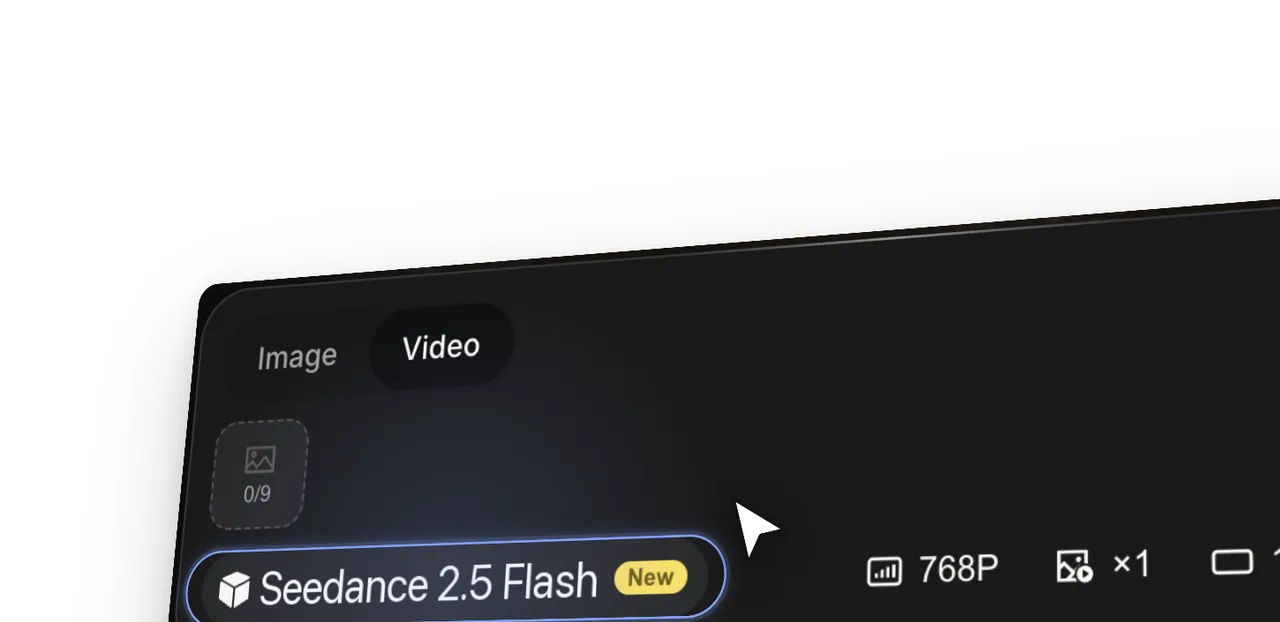
Short answer: omni reference controls what is in the shot; first-and-last-frame controls where the shot starts and ends. If your problem is "the product or character keeps changing", use omni. If your problem is "the clip does not arrive where I need it", use first-and-last.
Both modes exist in Noiz Studio's video panel today, alongside the model picker that currently lists MiniMax H3 and Seedance 2.0. The rest of this piece is about choosing between them, and about what each one quietly hands over to the model.
What each mode actually hands over
Omni reference means: here are the things that must appear, compose them into a shot. You supply content — a product, a character, a room — and the model decides framing, camera behaviour and how the elements relate. Multiple references can be combined, which is the point: product plus setting plus styled reference, in one shot.

A conceptual picture of Omni-style reference: several stills inform one composition. It is a simulation of the idea, not a capture of the live Studio UI.
The trade is explicit. You get content fidelity across several inputs; you give up control of the trajectory. The model may choose a camera move you did not ask for, or connect two references in a way you did not imagine.
First and last frame means: here are the two endpoints, invent the middle. You supply the start image and the end image; the model supplies the motion between them.
That trade is the mirror image. You control the arrival — exact composition at the end, exact product position — and you give up control of how it gets there. A path that is physically impossible will be faked, not refused.
The decision, in one question
Ask: if the clip is wrong, what will be wrong with it?
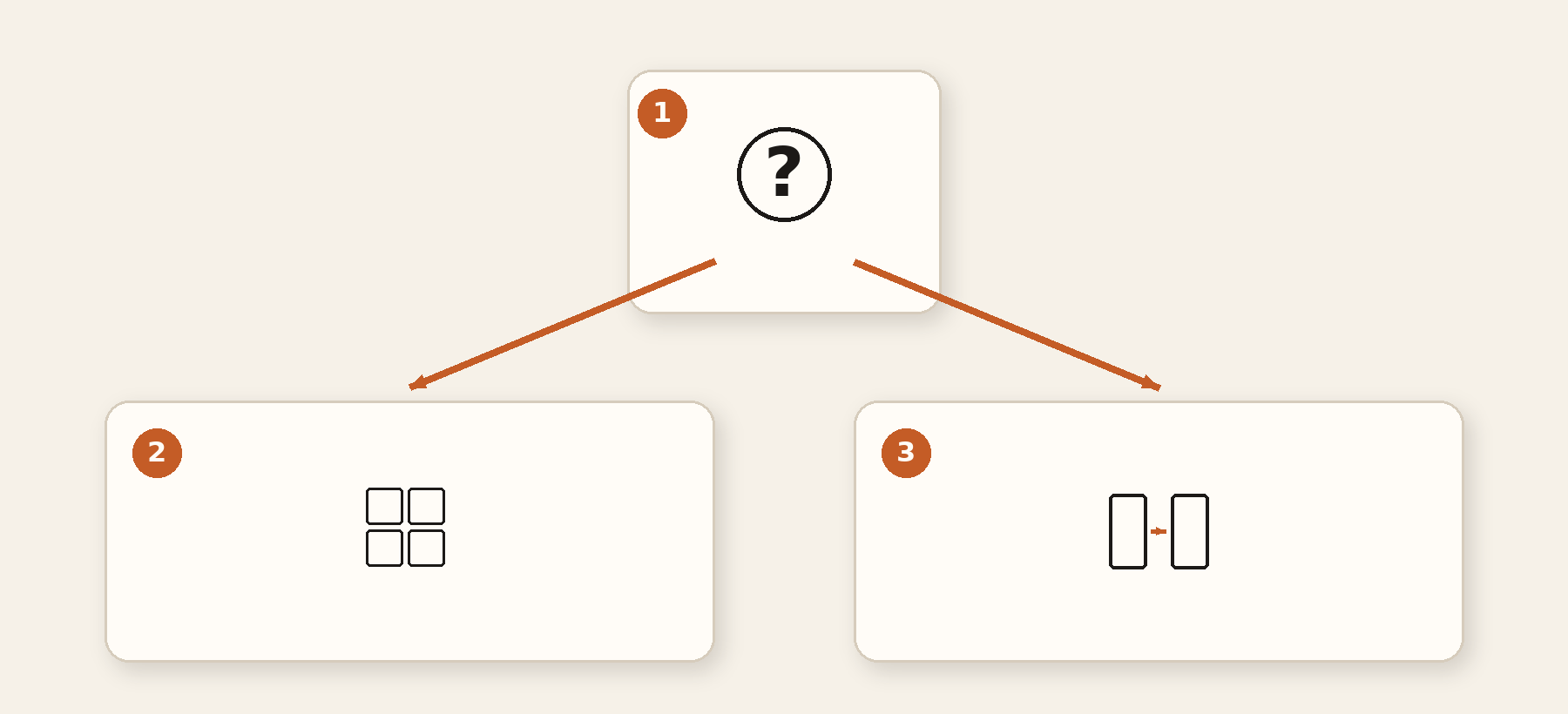
One question, two input modes: a set of references (left) versus a start and an end still (right). This is not a screenshot of the Studio control, and it is not a quality comparison.
- Wrong content — the product changed, the character drifted, the room mutated → omni reference.
- Wrong arrival — the product ends up off-centre, the camera ends somewhere useless, the reveal does not land → first and last frame.
If both would be wrong, you need two shots, not one clever mode.

Where each one earns its place
Omni reference fits:
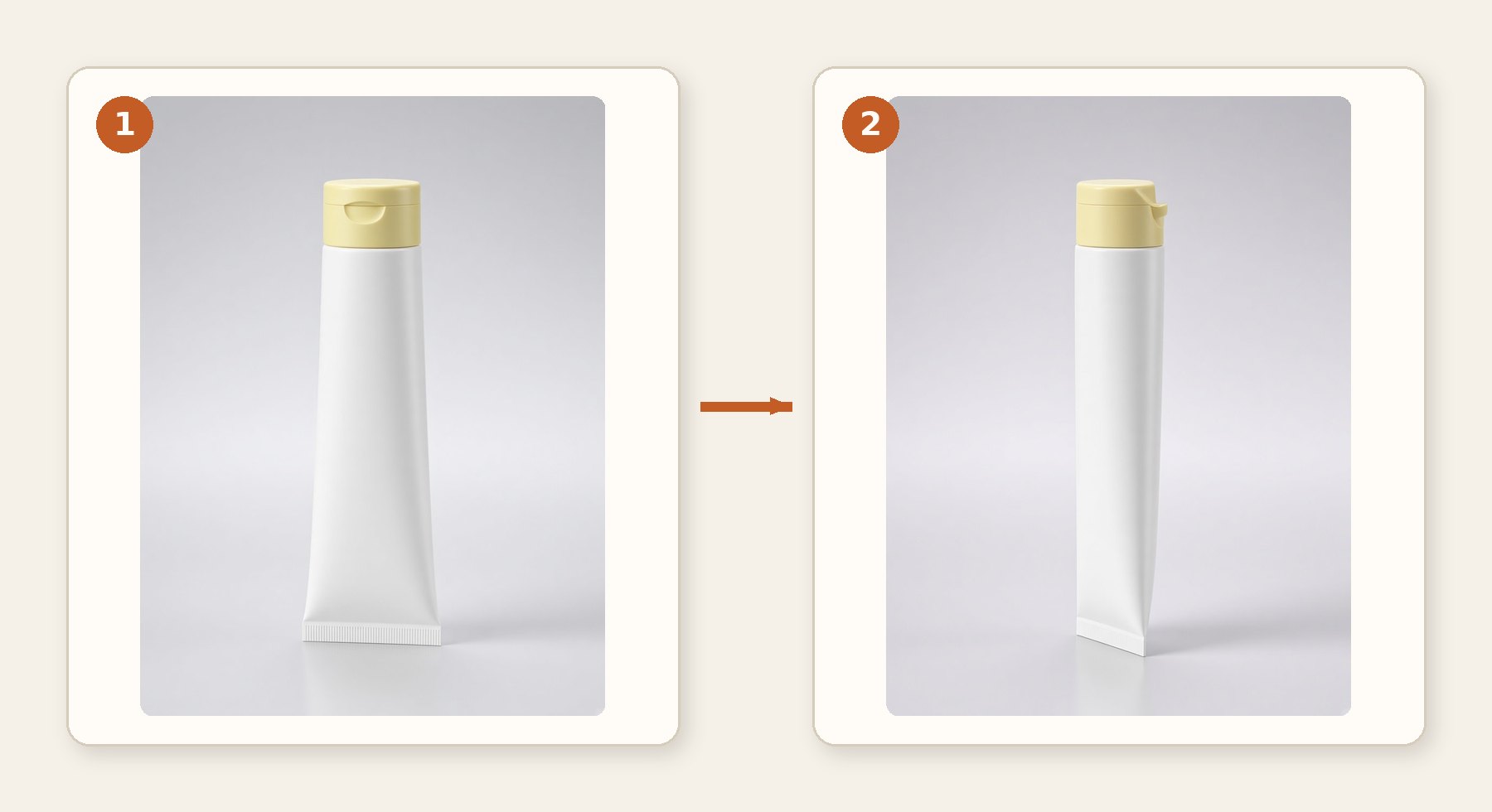
A simulated first and last still — two posed photographs, not frames produced by a video model and not a picture of the Studio first/last-frame control.
- A product that must stay identical while the environment changes.
- A person or character whose identity has to survive the clip.
- Multi-element scenes: product plus prop plus setting, combined in one take.
- Exploratory work, where you want the model to propose a camera move.
First and last frame fits:
- Product reveals where the end frame is the money shot (the pack centred, label forward).
- Transitions: open a box, end on the product; start wide, end on a macro.
- Loops, where the last frame must match the first.
- Any shot with a delivery requirement — a placement that must be exact.
Failure modes, and what they teach you
Omni: continuity drift. The product is right at the start and slightly wrong at the end, because nothing pinned the destination. Fix: shorten the clip, or add a second reference showing the product's final state.
Omni: unwanted camera invention. You asked for a product shot and got a push-in. Fix: state "camera locked off" explicitly. This mode is generous with movement; be explicit if you do not want any.
First-and-last: impossible interpolation. The two frames are too far apart — different angles, different scale, different background — and the model produces a morph rather than a move. Fix: bring the endpoints closer. Two frames that differ by 30 degrees interpolate; two that differ by 180 do not.
First-and-last: dead middle. The endpoints are fine, but nothing happens between them, and the result is a slow slide. Fix: put the action in the middle by choosing frames where something must change (a lid opening, a hand entering).
A working procedure
- Write the sentence first. "Product rotates to face camera, ends centred" tells you it is a first-and-last job. "Product in a real bathroom, unchanged" tells you it is omni.
- Prepare the inputs the mode needs. Omni wants clean, isolated references — one product, one character, one room. First-and-last wants two frames that are close enough to be believable.
- Generate three, review blind. The mode choice is a hypothesis; three candidates tell you whether it was right.
- Change the mode, not the prompt, when the failure is structural. If the content drifts, more prompt words will not hold it; switch to omni with a stronger reference.
If you want to test both modes on the same shot, open the Noiz Studio video panel, attach the same first frame, and switch only the reference mode between takes.
What this is not
This is not a claim about which mode produces better motion. Neither mode is a quality setting; they distribute control differently. A shot can be excellent in either and unusable in either.
It is also not a model recommendation. The reference-mode choice and the model choice are separate decisions: pick the mode by what you need pinned, and the model by what it is good at holding.
FAQ
Can I use omni reference and first/last frame together? Treat them as exclusive per take. Combining them in one request is not a documented Studio behaviour, and mixing the two control metaphors makes a failure impossible to attribute.
Does first-and-last-frame need a generated end frame? Not necessarily — an end frame can be a product shot you already own, or a frame pulled from a previous take. What matters is that the two endpoints are compatible.
Why does omni reference sometimes ignore one of my references? Because it composes rather than assembles: with several inputs, the model weighs them. Fewer, clearer references win over many ambiguous ones.
Is first-and-last frame better for loops? Yes, when the end frame is the start frame. It is the simplest way to make a clip that repeats without a visible seam.
Which mode should a beginner start with? Omni reference, on a simple product shot with one input. It fails in ways that are easy to see, which makes it a better teacher.
More production notes: the Noiz blog index.